EQUALITY WINS: Miami Beach, Tallahassee Refuse to Bend to Anti-Diversity in Local Government Law, Preserve Inclusive Funding
Local leaders showing up boldly as the intended chaos and uncertainty of the new law ripples across Florida
Anti-Diversity in Local Government Law poised to disrupt local economies already reeling from soaring costs, stagnating tourism
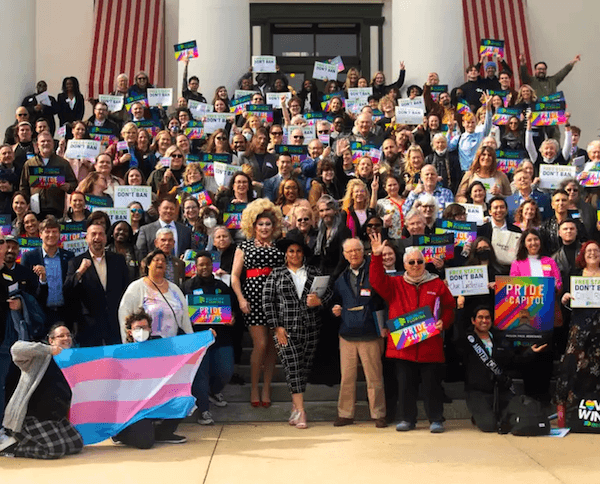
MIAMI BEACH, Fla. — Wednesday night, local leaders from one end of the state to the other stood up for their diverse communities and pushed back on Florida’s new Anti-Diversity in Local Government law. Their proactive steps are protecting support threatened by the law.
Facing the new law’s vague and sweeping prohibition on local support for policies, programs, and funding related to race, color, sex, ethnicity, sexual orientation, and gender identity, the Miami Beach and Tallahassee City Commissions preserved crucial funding for diverse, inclusive programming – especially for LGBTQ issues particularly targeted under the law.
“Thank you to the unwavering local leaders who stood up for their community and refused to abandon their constituents and their values,” said Jon Harris Maurer, Equality Florida General Counsel and Public Policy Director. “LGBTQ people are part of the fabric of this state — as residents, business owners, workers, visitors, families and community leaders. Protecting Pride and other inclusive programs recognizes that welcoming communities are the lifeblood of our state and a message to leaders across the state: do not comply in advance or concede your authority beyond the law’s scope. Every Floridian deserves a state where their local leaders have the freedom to champion their communities. That’s the Florida we’re fighting for.”
Local governments are scrambling to analyze the law, apply potential exemptions, and preserve funding for key community and cultural programs before the law’s effective date, January 1, 2027. For example, last night from the dias the Tallahassee City Attorney revised her analysis to identify a carve-out that should protect support for the local Experience Asia and Filipino Festival, which had been slated for defundingThe law is forcing local governments to spend valuable time trying to decipher what support they can and cannot provide for their communities. Rather than focus on the issues keeping Floridians up at night, local leaders are navigating a chaotic maze of vague restrictions, legal questions, and competing interpretations.
Still, leaders in Miami Beach and Tallahassee were able to chart a path forward for key programs in FY2027, including:
- $250,000 for Miami Beach Pride, which attracts nearly 200,000 visitors annually
- $47,000 for the Pridelines Community Center’s efforts to combat HIV
- $25,000 for the Miami-Dade County LGBTQ Chamber of Commerce
- $12,500 for the Miami Beach Police Department’s LGBTQ Outreach Program
- Maintaining contract funding and staffing for Tallahassee’s Commission on the Status of Women & Girls
- Fully funding support for Tallahassee Pride, Experience Asia Festival, and the Filipino Festival
In Miami Beach, where the LGBTQ initiatives had been slated for across the board defunding, Commissioner Alex Fernandez introduced a measure co-sponsored by Commissioners Tanya Bhatt, Laura Dominguez, Joe Magazine, and Monica Matteo-Salinas to allocate funding to Miami Beach Pride and the LGBTQ Chamber of Commerce prior to the law’s effective date. During debate, Commissioner Bhatt amended the proposal to similarly advance part of the Miami Beach Police Department’s (MBPD) LGBTQ Outreach Program. The measure passed unanimously in a bipartisan vote. The Commission had also helped Pridelines hone its funding request to avoid potential complications from the new law.
Additionally, the Commission committed to seek court confirmation that the city can contract to provide multi-year funding for such events and initiatives, as a more long-term solution.
In Tallahassee, Mayor Dailey balked at the idea of eliminating funding for key community events and programs that enjoyed such deep and longstanding community support at the behest of Governor DeSantis and the legislature. Instead, he pressed the Commission to honor their commitment to the community and fully fund the programs, which the full commission enthusiastically supported.
THE LAW’S COST: CHAOS, CONFUSION, AND ECONOMIC PAIN
The Anti-Diversity in Local Government law, championed by Governor DeSantis, places new restrictions on how counties and municipalities can fund, promote, and carry out certain programs, policies, and official actions related to diversity, equity, and inclusion.
While the law does not take effect until January 1, 2027, confusion and threats of overcompliance are sweeping the state. Apopka Mayor Nick Nesta recently unveiled a draft budget that called for slashing funds for the Martin Luther King Jr. and Christmas parades, Halloween in the Park, Breakfast with the Bunny, Holiday Tree Lighting, the 4th of July, Emancipation Day, Hispanic Heritage Celebration, Juneteenth, Memorial Day, Veterans Day, and more. Cities and counties are reevaluating successful programs to support minority-owned small businesses and local food and culture festivals. Miami-Dade County is considering eliminating key advisory boards and slashing grant funding to communities that most need it, and in St. Petersburg, even St. Patrick’s Day celebrations could be eliminated.
Upending inclusive programming and community support doesn’t just send a devastating message to millions of Floridians, it is a drag on local economies already strained under the weight of soaring costs and slowing tourism. Pride festivals alone generate tens of millions of dollars for local economies across the state each year, easily returning on local governments’ investments in them. The same is true for cultural celebrations, festivals, and more. And investments in inclusion and diversity more broadly, like minority-owned business grant programs and support for organizations aimed at lifting communities who need it most, make municipalities stronger. Ample data show that inclusive, welcoming cities attract more talent, build more diverse economies, and are more economically resilient.
THE MOMENT CALLS FOR BOLD, COMMUNITY-CENTERED COURAGE
The courage of Miami Beach and Tallahassee leaders sends a clear message to others around the state: do not comply in advance or hurl your local government beyond the law’s scope. These cities join others like Key West in pushing back, as it recently allocated $25,000 for an LGBTQ art installation prior to the law’s effective date. Programs and events can still be funded prior to the law going into effect. Pre-existing contracts can be honored. Public safety support can still be provided. Grant applications can be revised. Florida is months from the implementation of this law, still clarifying its contours, and its language doesn’t require that local governments abandon the communities they were elected to serve.
###